Tuesday, June 23, 2009

Time on the Air


Since arriving in Suriname nearly six months ago, Taylor and I have prayed, strived, and persisted in learning the Aukaan language (and culture) with the intention of sharing the gospel. Considering we are here as missionaries, any striving less than this ultimate goal would make us two deceitful religious rogues. Lol. I reassure you, this is not the case. We have shared Bible stories and engaged in spiritual conversations as fast our language ability has allowed. Each successive trip saw more opportunities and almost daily discussions that one way or another involved the Lord. Our most recent trip to the interior (which was unfortunately cut short due to the pressing need to rectify our stay papers) saw the culmination of five months’ worth of language of learning. We got to share our testimonies through a surprising form of communication relatively recent to the jungle: the radio.

Ditabikii possesses the sole radio station for the entire interior. For Aukaaners and some of the other ethnic groups living within a 100 mile radius, the station, known as pakati was built by previous missionaries some of which include our supervisor Charles Shirey. The construction and broadcast of this radio station was one of the primary ways Southern Baptist missionaries served and invested in the Aukaan people. The radio broadcasts news, music (Christian and secular) and has a “Christian” hour where Bible stories are played every night at 8 p.m. ironically; we didn’t have a radio ourselves and so only heard what was faintly audible from the station located in our backyard. We first shared a short message in Aukaan introducing ourselves and briefly describing our purpose here while ending with a Bible verse.

We didn’t have a full understanding of how popular and widely-listened to the radio was until the subsequent days when just about everyone we talked to mentioned hearing us that Saturday night. We had rehearsed what we were going to say and carefully wrote the words and constantly practiced but the Lord really anointed it. Our language teacher Ba’Joti who gave a formal introduction later told us: “a be go gaata” (It went smooth)

With a limited amount of time in the Jungle, a newfound confidence in speaking Aukaan and a well-received response from villagers we made it a goal to get on the air again. After a week or so of writing, rewriting, reciting and proofreading we had our testimonies written and ready to present. And so on a Thursday night @ 8 we first prayed for the Lord to bless what would be said and for the Holy Spirit to move in the hearts of hearers. I went first, gave a brief story of my childhood, how became a Christian, how God called me to be a missionary here and the reason we have come all the way from America to Suriname. This being that Christ loves compels us, he desires a personal relationship with every person and he’s the only way to eternal life. Taylor followed with a similarly ordered testimony. The total time amounted to less than ten minutes.

Just as with the first time, many Aukaaners in the villagers heard us that night and told us so. We were delighted, not because we spoke the language intelligibly or local notoriety resulting from two white guys speaking Aukaan but because what was said was the gospel message. We were privileged to share our testimony to a greater number of individuals than what could’ve been during the whole five months. We pray that people residing in villages where we’ll be spending the next 15 months heard of our impending arrival and most importantly, the Holy Spirit planted a seed in some of their hearts.

The Bible says in Proverbs 16 that the Lord works out everything for his own ends. Reflecting back on our short broadcast, it made me realize how something as simple as a radio can be used by God to spread his message of Love, redemption and salvation. It’s of no consequence which medium is used to propagate the gospel. What matters is that the message is preached. Jesus told us that before he returns the gospel will be proclaimed to all nations. We further realized as missionaries how our purpose is to be obedient to Jesus’ call and simply share the good news. The transformation of individual lives is the Holy Spirit’s role. That’s a huge relief and takes a lot of pressure off us as Christians. It’s exciting to think through what means and circumstances God will use to save souls in Suriname.

Sunday, April 26, 2009

Giving and Sharing

Long before arriving in Suriname and even before applying to become a Journeyman, I had heard it said by those with experience on the mission field that the Lord will change you just as much as you hope or think you will change the lives of those around you. For the last four months, I’ve seen the Lord challenge me in countless ways, more than ever before since being overseas. One particular area where God has shown me I need change is in generosity and giving. Circumstances in the ministry here have revealed to me how far I fall short when I read the words of Jesus: “Give to the one who asks you, and do not turn away from the one who wants to borrow from you.” -Matthew 5:42, “But love your enemies, do good to them, and lend to them without expecting to get anything back.” –Luke 6:35

It has been fairly easy to tithe my income (no matter how small) since I’ve been taught the importance of doing that from a young age. I continue to do this as an act of obedience as the Lord tells us but in one aspect it isn’t as a major sacrifice. This last month I read Mere Christianity by C.S. Lewis (thanks for b-day gift Taylor) and in a section on Social Morality he states: “I do not believe one can settle how much we ought to give. I am afraid the only safe rule is to give more than we can spare. In other words, if our expenditure on comforts, luxuries, amusements, etc., is up to the standard common among those with the same income as our own, we are probably giving too little. If our charities do not at all pinch or hamper us, I should say they are too small.” This really hit me because what the Lord was telling me was that I could and should give more.

To most of you, seeing the amount of money I’m bringing in would perhaps evoke thoughts of empathy for how much I was giving up when contrasted with what I could possibly earn in the U.S. That argument holds water until you live in a village like Ditabikii where you are hands-down wealthier than everyone around you. It’s amazing how even a single possession you own is more than people make in months or even a year here. So you can’t default to comparisons of your peers in America. In the states where most people aren’t persistently asking to borrow from you or for The Lord has given you more financially than those around you and the Biblical response to this is to be even more eager to share with those in need. In Luke’s gospel (12:48) Jesus tells us: “From everyone who has been given much, much will be demanded; and from the one who has been entrusted with much, much more will be asked.”

In the states (at least in my experience) most people aren’t persistently asking to borrow or to have your possessions. You aren’t tested in your willingness to share as you I have been in Suriname. On a daily basis here people ask to borrow much of what we have. This includes various tools, machines, our boat etc. Sometimes kids or even adults will come by asking us to cook something for them. We buy food for ourselves and don’t have a ton to spare. Our friends will call asking us to buy them things in the city to bring back interior. While we have given more often than we’ve held back, my heart has too often been in the wrong place. I find myself internally grumbling and questioning and dreading….giving. And at that very moment I am aware how God judges the heart and I am convicted that I shouldn’t think this way. So in one way this is sort of a confession to all of you. I definitely have not “arrived” yet. I ask God to continue to change my heart to be more generous and to not do so grudgingly. On a positive note, the very fact that I possess the realization that I am not where I should be is a sure sign of improvement. I desire to be the “joyful giver” the word tells us God loves. When I face the realization that the Lord owns everything and he entrusts us with possessions to use for his glory, I fully grasp why it’s important to be all the more eager to share.

A trip to the Planting grounds

Often, it happens in life that you experience one of those days in which the events that transpire seem to sum-up all that you’ve been doing. The experience is a kind of snapshot displaying a little bit of everything. Our trip to the goon (planting ground) was one of those days. One Saturday, Ba’Jepin invited us to go with him and his family to the goon (it is actually pronounced goan and yeah it was pretty funny when I first saw it spelled as well). We grabbed our gear, the equipment we bring everywhere we go, (machete, sunscreen, food, water, first aid kit, poncho etc.) took a ride up the river in the boat to a location where only Ba’Jepin himself could’ve known. There was a trail that began right at the bank. We tethered the boat to a tree, hopped out and began to hike. The path led us to the heart of the bush with all the sights and smells we have become so well acquainted with: namely the sweet floral scents of with the occasional peculiar odor signaling the presence of a snake.

We reached the goon after close to a mile of hiking. The typical Aukaan goon is a sizable acreage located away from the village where rice, corn, cassava, melons and other vegetables are grown. This food is primarily grown for each family’s consumption. The goon is farmed by slash and burn tactics and the land’s fertility is sufficient for only one season. As a result the location changes each year. A new tract of land is cleared and trees burned during the dry season and the seeds are sown to be harvested months later. The goon is far from the symmetrical, uniform American farm you see with evenly ploughed rows and spacing. The goon is littered with charred trees too large to burn and various plants and grass as tall as a man. Stalks of rice are growing in between all this. From the time we began work, Sonya, Ba’Jepin’s wife went into the field and picked stalks of rice by hand in the blazing sun with only a knife and a sack for the entire afternoon. We did some of the picking ourselves and learned how harvesting rice in this fashion is an extremely tedious and time-consuming process. We’ve participated as well as witnessed the complete process from harvesting rice to cooking it ourselves (there are a few more steps in between including pounding the rice in a giant mortar and pestle to remove the husk before sifting). We’ll never look at rice the same.

But our primary purpose was to help Ba’Jepin build a Masanga. The masanga is a thatched roof hut, a little house on the planting ground. The structure is made of wood and and palm branches; there exists not a single piece of synthetic, manmade equipment. We learned vicariously as Ba’Jepin demonstrated how to arrange and fasten the branches. For rope we used a kind of strong vine called Camina. It was strong and flexible and he told us he had looked deep in the jungle to find. As we were close to finished, much to our dismay we ran out of camina. How were we going to finish the Masanga? Not a second after he realized our means of tying was gone he told us to come with him to the edge of goon where the jungle began. Not ten meters in he had us cut down a certain plant, peel back the stem into thin strips and had us fasten them together to function as rope. It worked surprisingly well. We were able to finish the job. Taylor and I looked at each other in amazement. As we would soon find out, it would not be the last time. The roof was soon finished and was a quality piece of work: fully waterproof and would last at least two years.

The rope improvisation was an impressive feat but the highlight of the day occurred when we ventured back into the bush and began to hack down a number of medium-sized trees with trunks soft enough to felled with our machetes. The Palm-like leaves were saved for the masanga roof and Ba’Jepin’s sons mentioned to us something in Aukaan about the tree being edible. We were sure we hadn’t heard correctly. After all, we’ve only been learning the language for three months now. They insisted that this in fact was what they called Gruntu udu “vegetable wood”. They peeled back the bark to reveal a white soft core they proceeded to chew. We were skeptical to say the least, but after having already dined on Aligator, chickens feet, and Armadillo we thought we’d give it a shot. And so we ate it. It was bland but the taste was agreeable. Now we know one edible plant we could survive on if needed. It anything else, we can say, “We ate trees in Suriname”. The whole day was filled with demonstrations of ingenuity by using what the land provided. We weren’t witnessing a session on jungle survival. This was a normal family whose means of subsistence involved doing “survival” type things. The trip to the goon was an awesome learning experience, not because we ate gruntu udu or made twine out of leaves but because we were privileged to be part of a weekend family outing Suriname-style. We had the same feeling you get when you go out with your family on a recreational outing in the states. Ba’Jepin and the kids laughed at inside jokes, the boys enjoyed hacking-up trees with the machete and the Sonya and Agwena cooked. For many Aukaaners trips to the goon are the fun weekend activity everyone looks forward to. We couldn’t have asked for a better way to spend a Saturday.

Thursday, March 19, 2009

A change of Plans

In the book of James beginning in chapter 4 v.13-14 the author gives a stern warning to those who make boasts about the future. “Now listen you who say, “Today or tomorrow we will go to this or that city, spend a year there, carry on business and make money.” Why, you do not even know what will happen tomorrow…

You might be wondering why you’re reading this blog in the third week of March when I said I would be in the jungle by March 11. Here’s where this passage in James pertains to our present situation.

The time we have spent in Paramaribo since March 4 has been a whirlwind of various natural and manmade obstacles. When we got to the city and quickly began to run the various errands that come with a six-week period away. We scheduled a flight back into the interior for Wednesday March 11. We were told that flights were not going out the day because of a Hindu national holiday in Suriname (Suriname is pretty diverse, 30% of the population is Hindustani- besides, most aren’t quick to fight a state mandated day off from work- regardless of what it represents) So, there was a possible flight on Thursday to Ditabikii which we tentatively penciled in….and then came the flood.

After hearing rain pour for most of the night in a state of quasi-consciousness that prevented me from gauging intensity of it, I woke up, walked into the kitchen and onto a floor fully covered in a thin layer of water. Shocked, I looked outside and saw our street which had become a canal and came to the conclusion that the rain apparently fell so fast and so hard that night as to rise and creep under our front door. From there it found its way into our front room. Thankfully, our house is covered in tile and it was possible to sweep out all the water with a squeegee. As you can guess, much of the city was inundated. The rain, continuing to fall for three more days didn’t help. As a consequence, flights were canceled. Our next planned departure: Saturday.

We told our families we’d be leaving a little later and told our tutors in the interior the same. Later that week we just needed to finish a few details with our stay papers and we’d be golden. However, as with all document work it was not as expedient as we had anticipated. Everyday brought forth a new development that couldn’t have varied greater than the previous day’s. We were sitting, waiting, wishing…and didn’t dare venture to make any more predictions about when we would be heading back.

As we woke up each day having no knowledge of how long our wait would be, the words of the Apostle James were continually coming to my mind. So to finish the passage James says in vs/ 14-15, “What is your life? You are but a mist that appears for a little while and then vanishes. Instead, you ought to say, “If it is the Lord’s will, we will live and do this or that.”

While I feel that me and Taylor have been far from making rash predictions or absolutes about our future we have been made further aware of how so much of our life is outside of our control. We are “a mist that appears for a while and then vanishes”. For now (If the Lord wills it) we are heading to Ditabikii Saturday and have a tentative date of return sometime during the last week of April. Thanks for all your prayers and this blog will be updated if/when we get back. :)

As I was reading my devotions today I came across a verse in Proverbs quite applicable both for me and all of you.


“Many are the plans in a man’s heart , but it is the Lord’s purpose that prevails.” Proverbs 19:21

Thursday, March 5, 2009

40 days: perspectives and reality

40 Days. Moses spent 40 days on Mount Sinai without eating bread or drinking water when he wrote on the tablets the words of the covenant-The Ten Commandments. Jesus spent 40 days and forty nights, also without eating or drinking in the desert to be tempted by Satan. Ryan Rindels and Taylor Ivester spent 40 days deep in the jungle of Suriname…where they did eat some bread and water. Okay. So we didn’t abstain from food or drink for a month and a half but on more than a few occasions I felt my share of hunger and consequently further came to grasp how blasphemous it would be for me to even remotely put myself in such a category. In many ways, life, and the job I signed up for (in what seems like ages ago) is exactly what I expected it to be. But in an equally surprising number of categories it couldn’t be farther from what I anticipated. Whatever my preconceived notions, I am strengthened in my resolve that this is where God wants me…and oh yeah I’m having a blast.

So now you’re probably asking yourself, “well is he actually going to describe how life is different or the same as expected?” To that I will elucidate with as much or as little as I think (or hope) you would want to read without yawning or lamenting that another blogger doesn’t know when they have exhausted their reader’s patience.

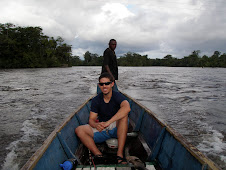
Life and culture where we live in the interior is as close to a pure paradox as anything I can contrive. Here are a few examples: the boats people drive on (we live on a river so that’s everyone’s mode of transportation) are essentially oversized canoes made from giant trees felled and then hewn out with a combination of fire and axe. They are then painted and engraved by hand with tribal carvings….and then powered by a Yamaha 75 HP engine running on gas and oil. Needless to say these canoes have some giddy-up. Music: a typical scene as we glance from our house across the river is kids bathing in the river fishing with cane poles, a group of women cooking rice over a cooking fire in a small hut…to the background of bumping Reggae music from some dude’s stereo. Electricity comes to the village through a giant diesel generator that runs for a few hours each day. Of course the fuel is brought 100 miles upriver in….you guessed it, the motor-powered canoes.

For some reason me and Taylor (and more than likely some of you) thought we would be in remote areas away from civilization, living-off the land and then thriving in such conditions. We were wrong in two out of three of those categories. We are in a remote location: true, but the jungle doesn’t provide much naturally for regular nourishment. There is enough to survive in the bush, but that’s all you’ll be doing… surviving, and that’s a full-time job. When traveling on the river, the jungle is so thick that you cannot even dock your boat, you hit a wall of foliage and palms called Maka that are covered in thorns so dreadfully sharp you knew God created this specimen post-fall.

So Taylor and I, with our romantic notion of living like Bear Grylls for two years quickly vanished. We bought our food in the city and incidentally underestimated our daily consumption. We still went hunting but came back empty handed and were elated to still have peanut butter and jelly in our cabinet. But with much of survival appeal gone to the wayside the Lord taught me that what really mattered and the reason I am a missionary was simply this: the people. Living with them and showing the savior’s love with the hope that they will come to faith in him was the only thing I should care about. If that means dozing to sleep in a hammock one night to the sound of a bumpin’ stereo then I’m fine with that.

I’ve learned to appreciate any amenities I possess and have gladly used them with an understanding that God has given them to me for a reason. So this sounds like no place you’ve never heard of…it’s different for sure but God is working here and the gospel possesses a power of it’s own that crosses any and all culture boundaries. In the Mark 4:26-27, The Parable of the Growing Seed Jesus said, “This is what the kingdom of God is like. A man scatters seed on the ground. Night and day, whether he sleeps or gets up, the seed sprouts and grows though he does not know how.”

Manna...just enough for each day

So maybe it was a culmination of 23 years’ worth of mom’s cooking and dad picking up the grocery tab. It might have very well been attributed to a 16 meal-a-week plan in college at a top-rate all-you-can eat cafeteria. It could have even been the sight of $700.00 SRD on a receipt (and my failure to register that one U.S. dollar makes $2.80 Suriname dollars) at the grocery store that acted as a deterrent. Whatever the possible causes, the reality as we soon found out wasn’t quite as ambiguous: we didn’t bring enough food.

When planning our meals we glossed over important nutritional and calorie packed foods. For instance, a half cup of tomato sauce for our spaghetti packs a mere 40 calories! Needless to say, spaghetti always left us wanting. Unfortunately, we don’t have a freezer so our chicken beef had to be consumed within the first few days. That gave us no real meat outside of canned tuna for the remaining 4 and-a-half weeks. We somehow thought that one oatmeal packet and a piece of bread was a sufficient breakfast.

We optimistically factored catching fish as part of our protein for some of our dinners.….we have yet to catch one fish (beyond small bait ones). We discovered that during this time of year when the water is high fishing is poor. We failed to factor in snacks for in between meals. In addition, with a fridge that works no more than twelve hours a day there began a race against mold on my bread. We somehow thought two jars of peanut butter: one small and one large would cut it. Needless to say, we found out quickly that at our normal (conservative) eating pace we’d run out of peanut butter, milk and bread. Our days were planned out in intricate detail documented with what we could eat from that day to the end. Towards the end of our trip, our post-dinner discussions would involve vivid details of our favorite dishes and what we planned to eat once we got in the city. I felt like a prisoner of war, starving and incessantly fantasizing of food. We treasured our precious snacks and would call to attention whenever we were about to consume it. It was peculiar and intriguing how watching Taylor down a savory snack and then asking him how good it tasted delighted me.

You all know how much I love to eat anyway and how active of a life I lead. Out here we were a steady share of hard work and vigorous exercise on a daily basis. I’d made an effort heartily during Christmas break and before I left packed a solid 170 lbs. I weighed myself last week…152. Don’t fret though, I’m healthy, just devoid of any body fat. What appears to be a situation worthy of your sympathy is actually a blessing and builder of faith. God provided for us through various people and sources to give us our daily bread and we have been as appreciative and grateful in an unprecedented way.

Here are a few of the ways:

-The Lord has blessed us with relationships with locals in who have on a regular basis given us watermelons grown from their own gardens

-Creation itself: There are mango trees everywhere and we pick as many of the delicious fruits as we can. We love em!

-Newfound friends: one day some guys came to our door accompanied by a career missionary from another organization. We discovered they were U.S. military and embassy guys checking out the interior on a short trip. We met them at an Aukan wedding the next day and befriended them. They knew our situation and offered to give us MRE’s (Meal Ready to Eat) they had and wouldn’t be eating. We were delighted and ecstatic and they guys even invited us for dinner at their house when we head back to the city.

-A girl who is a Peace Corps volunteer was heading back Paramaribo and coming back offered to pick-up anything we needed. We took her up on it.

-our supervisor Ted surprised us by sending out bread and powdered milk one day.

The way it ended up, we used and needed every item given to us. We always praised God for each of these gifts and being that I was in Exodus for my devotional reading much of last month I couldn’t help but feel some real personal application when I read how God provided Manna and Quail for the Israelites and gave them only what they needed each day and nothing more. The Lord provided Manna for us and I have no doubt he will continue to do so.

So Simple..and yet profound

It’s pretty well known to most folks that a missionary’s first months (and for some up to a year) are spent learning the language of their respective culture. For many, this is often a time of previously unknown frustration, timidity, and confusion in the realm of basic communication. It is also an inevitability that a language learner will commit more than a few humorous gaffes. The truth remains that you have to keep trying and make mistakes in order to improve. In all likelihood those around you will be quick to correct any major errors you commit or anything you’ve said offensive. Our language teacher Ba’Jepin was teaching us a few Aukan terms for using the restroom when he asked Taylor and I what do you call that?…... then uttered an ubiquitous (apparently) four-letter word with an unambiguous connotation familiar to any English speaker with innocence, curiosity and sincerity. We immediately rolled with laughter but were quick to tell him that that was an “ogii wootu”- a bad word and it would be advisable not to use it. While I have yet (at least to my knowledge) to make any major linguistical blunders I’m sure my time will come.

For Taylor and I “language school” has been a little more informal and unconventional than many of our colleagues in other parts of the world. Currently, a majority of our language learning is done at our house for three hours or so each day after breakfast and before lunch. We have two language teachers who can show up anytime on any day or not at all. (this is the norm as we quickly discovered). The rule is as follows: if they don’t come it’s expected and you move on to something else, if they show up, you stop everything and do language or whatever else with them for as long as they want to stay. Finding people to speak with isn’t difficult. We paddle across the river from our house in our canoe most days, buy freshly-baked bread and chat with people. In addition, our house often resembles a public park: people and especially kids come over at any and all times of the day to stare at us, plead to come into our house or play with them. Between periodic sessions with our language teachers, interactions with locals and hitting the English-Aukan dictionary we’ve come a long way in six weeks. Praise God!

Like most tribal languages, Aukan is a simple language in grammar, pronunciation and has a limited vocabulary. This makes it simple to learn and speak but can frustrate a guy like myself used to an English language containing over 500,000 words. One word often has up to ten meanings (not counting additional idioms) in Aukan. An example is the word Nyan. The meanings are as follows: to eat, to bite, to sting, to rot-off, eat away, corrode, to waste, hurt or pain, to enjoy, to celebrate, food, fruit, crop, meat of a fruit. While most words have fewer meanings than nyan the pattern remains. The biggest language peculiarity to us was the word Lobi. It has two meanings but they differ to a profound degree: to Love, to Like. We couldn’t understand how they can use the same word for such definitions as vastly different as loving vs. liking. I pondered (and continue to do so) how relationships work here when it comes to male-female communication. I’m glad I don’t have to explain what I really meant when I said, “mi lobi yu”. Anyway, I’ll leave it up to you to ponder some possible humorous scenarios.

One of the ways I’ve continued to learn Aukan is by using my Bible, the Aukan translation of the New Testament, and a dictionary to transliterate the headings of passages into English. What I found was the simplicity of the language gave surprisingly profound spiritual truths and perspectives. Here are some examples: Matthew 5:43 Love for Enemies is: Lobi den feyanti fi yu enke na yu mati translated as: Love your enemy as you would love your friend. Matthew 6, Giving to the needy is: yeepi taawan sondee fu suku balinen translated as: Helping all without seeking fame or notoriety. In Mark 16, the Aukan New Testament gives a few extra passage headings. In verse 15 it states: Masaa Jesesi gi den bakaman fi en wan gaan wooko, Jesus gives the Apostles one big task. There are countless examples of entire verses that will touch your heart to read them transliterated.

In learning a new language it’s easier to see the importance of sharing the gospel in a particular ethnic group’s native tongue and why it greatly amazed the diverse group at Pentecost in the first century to hear the word of God in their heart language. So I’m on my way to being proficient enough in Aukan to share Jesus and God-willing, very soon.