With more than likely little knowledge of the interior of Suriname, what do you the reader imagine as being the two most commonly asked questions of me by Aukaaners? Think hard. There are no shortage of questions in the world. Before living here I would have never even known where to start so don’t beat yourself up for not knowing. Well, the two most common questions asked are these: You’re how old?...24! Why aren’t you married? and the second, “You aren’t afraid of (fill in the blank)? The former of these two…well, I’ll save that for another time…as in personal conversation, you probably don’t want to read a blog that long. Lol.
In our missionary training we learned of how sin manifests itself in (loosely) three different distinctive categories: guilt, shame and fear. Western cultures such as our own are guilt-based because we judge by law to determine right or wrong. In Aukaan culture fear pervades the lives of this people group and satan uses it to hold them in bondage to sin. Any time Aukaaners see me swimming in the river they are quick to warn me and admonish me to not go there. I have an answer ready but first ask them why I should be afraid. There is no good physical reason to fear swimming in the Tapanahoni, especially in the dry season with a languid current and an abundance of shallow places to take refuge if you become tired. None of the fish will attack humans so the only thing I am careful to take heed is sting-rays in the sand and the diabolical Makaa palms covered in thorns that occasionally lie just below the surface of the water. As of today, (October 17) I have yet to be stung by a sting ray nor have I gotten any sort of serious injury by a Makaa. All the praise to God for this.
Interesting enough, all the villagers who warned me about the river didn’t mention thorn palms or fresh water sting rays. They didn’t tell me I might drown because perhaps I’m not a good swimmer but they began to talk about spirits that pull you down under the water and drown you and all kinds of supernatural creatures and demons that seek out humans in the river. This might sound like myth and folklore that most in America would disregard as superstition. I’ve been here long enough to know the spiritual world and demonic oppression are so prevalent that I could never, as a believer deny that. So from there I begin from where I should’ve started anyway: The Lord. So I’ve told everyone who asks the question that I don’t know what’s under the water. I believe in evil spirits and perhaps there is something that can kill a person in the water but I believe in Jesus and I pray for God’s protection and the Holy Spirit that resides in all Christians keeps me safe not only in the river but everywhere I go. I put my trust in him to protect me and therefore I’m not afraid. This simple act of swimming in the river has had a great impact on villagers in Godoloho.
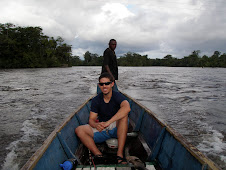
Taylor and I paddled in our canoe one night when I was down in Ditabikii for two weeks in October to another island in the dark and during a rainstorm. People were shocked and said, “They’re not afraid of anything”. We’ve taken every opportunity to give our Savior all the credit for this. That same week we spoke for an hour on the radio. Taylor interviewed me and I talked about swimming without fear and used the opportunity to share the Biblical account of Jesus and the demon- possessed man in Mark 5. Thousands heard this and I pray the Lord was and continues to be glorified in how we live our lives and that the manner in which we live them will be the biggest testimony of all.
Sunday, November 29, 2009

Saa' Bea's testimony

A true joy since arriving and doing ministry in Godoloho has been hearing the testimonies from believers in the village. I wasn’t sure what to expect when I got here concerning how these folks came to know Jesus as Lord and Savior. I had no preconceived notions because I knew how different life was here and people’s proximity with the spiritual world was so acute. I was sure that the story of how they came to faith would not be a typical answer you here back home. But what I heard and continue to hear had me listening in awe, wonder and amazement and praising God.
Nearly every testimony was a prolific story that invariably involved the supernatural. There were miraculous healings, visions and dreams. As time passed by I realized this to be the norm. I couldn’t wait to hear another story. I’m going to tell the story of one woman in Godoloho named Saa’ Bea whose testimony involved a miraculous healing, a dream and a steadfast faith of Job-like proportions.
As I sat down under the refreshing shade of a mango tree during a typical mid-morning Godoloho day eating watermelon and enjoying a cool breeze that would soon be forgotten as the hot mid-day afternoon hours arrived Saa Bea told me the following story:
She had been a believer for a while but her husband not (very typical scenario here). She had contracted some type of debilitating illness that essentially left her paralyzed below the neck. She told she couldn’t even lift a spoon to feed herself at more severe stages of this illness. She was a complete invalid and was at the mercy of her family to take care of her. She prayed fervently everyday for healing from God. She put her trust in Christ and said never doubted he would heal her. The unbelievers in her family and fellow villagers saw her feeble condition and urged her to seek healing from a Bonuman who would use magic, oracles, and other various forms witchcraft to attempt to make her well. She rejected all offers and held fast to her faith as sole healer. As time passed and her condition failed to improve, she was persecuted with increasing intensity as she would not even give the traditional medicinal treatment of the Aukaan people. Her neighbors derided, ridiculed and continued heaped abuse on her. They even made threats on her life and tried to convince her husband to divorce her and thereby remove his financial provision and care. One of her daughters, Esma (a Christian) stuck with her through this great time of trial and suffering. She tended to her needs during these years.
Then one day she had a dream. In the dream she saw Jesus. She said his face was as bright as the sun and his clothes a brilliant white. He told her in this vision to take a particular plant and make a certain wash with water and bathe in it. As she could not raise herself to retrieve the plant needed to make what the Lord had asked her to make, she begged her husband to do it. He did as she asked and she washed in it for three days. On the third day, she rose up and walked. An absolute miracle! All people in the village were in awe and acknowledged God’s power and his mercy towards Bea. A story of this magnitude was too wonderful to not ask others in Godoloho and surrounding villages. I asked two men who are non-believers about her and they both corroborated the story: She was paralyzed and became well miraculously.
As I sat in awe-struck wonder I posed the question as to what was the response to all those who witnessed the power of your God and your steadfast faith in the face of unrelenting opposition. She calmly answered that they did not deny the Lord’s power but did not come to repent or accept the God who did what no one else did or could. My eyes began to well up with tears as I saw the awesome power of Jesus and at the same moment the hardened, stubborn, rebellious and unbelieving human heart. I was quickly brought back to the Gospels in which Jesus did miraculous signs and wonders demonstrating his divinity and power over and above the entire world and everything which plagues and hinders humanity: even death itself. Pray for the Holy Spirit to soften hearts in Godoloho and the interior or Suriname. He’s revealing himself to many and bringing to himself those whom he is pleased to bring.
I couldn’t help but see in Saa Bea’s story Jesus words in the Parable of the Rich man and Lazarus:
“No father Abraham,’ he said, but if someone from the dead goes to them, they will repent.’
He said to him, ‘if they do not listen to Moses and the Prophets, they will not be convinced even if someone rises from the dead.’” -Luke 15:30-31
Sunday, August 2, 2009
A divine revelation

If you grew up as I did in Church every Sunday and Wednesday you heard sermon after sermon and Bible lesson after Bible lesson beginning in the nursery and continuing into adulthood emphasis was frequently made on faith and truly trusting God for guidance in life and divine revelation. The heroes of the faith were lauded for giving up everything this world had to offer trusting that what God promised them was infinitely better. It never ceases to amaze me how the Andrew and Peter dropped their nets one day, left their father, and followed Jesus. They had plenty of good, ostensible reasons for keeping their career and family. But now we read their story for no other reason than that they did leave those nets and followed Jesus.
Jesus told us to ask, seek and knock in Matthew but I’ve begin to see how seldom actually do it. Oh we ask, but when do we ask with no back-up plan, no alternative, no contingency? When do we ask Jesus, trusting that either we get an answer from him or don’t get one at all. When do truly walk by faith?
Since Charles, Brittany and his family have returned to Suriname our “orientation” period has been over. We just finished wrapping-up after a volunteer group came from Tennessee. (If any of you guys are reading this, just want to express how much I enjoyed you’re coming to Suriname and miss you) Now, with less than fifteen months left on my term it was time to decide where Taylor and I would be. We knew what we’d be doing: chronological Bible storying and discipleship, but weren’t sure exactly where we would be located. Realistically, most villages would be glad to have us and therefore we critically needed discernment of which one to stay. Prior to last week Charles had one place in mind for us to visit but none of us felt any particular place was where we should be. So last Sunday we’re sitting around the table with no clue of where we should be with every option on the table. Charles told us he wants us to be in the interior by Wednesday. Him and Brittany asked Taylor and I to entertain the thought of going to different villages and doing work separately. We got down on our knees and earnestly prayed that night for guidance. We asked for revelation through any and all means: dreams, a voice, a person, the Word etc.
Monday night came. We prayed together and went home and slept. In the morning I did my devotional and at one point I felt the Holy Spirit telling me of a certain village called Godoholo. Taylor had a dream that night of a certain man from a village right across from Ditabikii. Charles called and asked us if the Lord had given us an answer. He had given him and Brittany one. This was uncharted ground for me. Charles joked with me when we went to his house for lunch that if are answers didn’t coincide, someone got a word from God and someone got it from somewhere else. I was a little apprehensive to say the least about the revelation. So we sat around the table and told them what was revealed to me. When I said Godoholo they both looked at each other and smiled. Taylor then told us about his dream. Charles and Brittany prayed that night and told them that the Lord showed them that I should be in Godoholo and Taylor should stay in Ditabikii. We were in absolute amazement. God showed all four of us separately the same word. Incredible!
This faith step has really strengthened my walk with the Lord. Charles was not a bit surprised but told us that the Lord would not give us a contradictory answer. He tells us that those who seek will find, those who ask will receive and to him who knocks the door will be opened. And so Wednesday, we headed back interior and stayed for four days. We met with Captains from Ditabikii and Godohlo to ask permission to stay and tell Bible stories. It went really well. Although everything is yet to be finalized, God has shown us where he wants Taylor and I to be. God showed us how walking by faith pleases the Lord and he does not neglect us when we ask in his name.
Stating the obvious
On a sultry, star-filled night in the interior Charles, Taylor and I along with 5 volunteers from Tennesse who had come for the week to do ministry in the interior sat in semi-circle just outside Ba’Jepin’s house waiting for “church” to start on a Wednesday night. We arrived around sunset and waited close to an hour before two other believers from the island arrived. They had been busy finishing up some last minute (or hour) work. As you can expect, this was anything but your conventional 11 A.M Sunday worship service. Charles initiated the time by asking Taylor and I to share a story from the Bible God had led us to share. Taylor told the parable of the net in Aukaan with Charles and I translating for the volunteers. He made an analogy pertinent to the jungle referring to fish we had caught setting hooks one day, some of which had been eaten by an alligator and we’re therefore analogous to “bad” fish in the parable and others which we’re the uneaten “good fish”. The Aukaaners understood well and repeated back the story and what the significance was in regard to God’s final righteous judgment.
I then told from memory the story of Jesus calming the storm in Mark 4 and made some practical application emphasizing how the disciples had seen Jesus’ authority, might and unprecedented miraculous power and yet when a storm threatened their ship (with Jesus himself on board!) they cried out: “master don’t you care that we’re going to drown?”. In the same way, we see Jesus’ work in our lives and yet when “storms” come and the wind howls and the waves crash all around we are too often like the disciples because of our lack of faith. After telling this story with a voice which was quickly waning as I was coming down with a cold, a brother, Ba’Maliki repeated the story back to me from memory with striking accuracy. It is Aukaan custom to repeat a story back to the story-teller to demonstrate their understanding of it. I was impressed and blessed to witness this. Charles concluded by asking three of the Aukaan brothers one example of which they have seen God’s work in their life. They all described how the Lord has shown himself faithful and Charles himself also gave one in which he prayed to God for rain to put out a big fire. Taylor and I witnessed this and it seeing it strengthened our faith.
As it was getting late, we prepared to leave but Charles could discern that rain was coming despite previously clear skies. Sure enough as we began walk out it began to pour. We went back to take cover at the house and wait out the deluge. Just then another believer Um Langa, showed up just as we were concluding the meeting clearly sad that he had missed the meeting. The rain delay gave us opportunity to share the stories with him. Taylor and Charles told their to Um Langa. He was joyful afterwards and grateful the Lord had sent the rain in order that we could not leave and as a consequence, he did not miss a word from the Lord. As Charles drove us back in treacherous darkness on the perilous river where only a spotlight and prior knowledge of the location of rocks prevented a disaster those in the group reflected back on what Um Langa had said. He never once veered from the reality that God sent the rain that night, at that particular time for the sole purpose of him getting a chance to hear those stories. I quickly realized how quickly I glossed over what was simply the obvious: God working through (in this case) nature to allow Um Langa to hear the word of the Lord. There’s a lesson to be learned from our Aukaan brother. If we only looked more intently we’d see God’s work in our lives in the simple and ordinary just as much as the profound and miraculous. We’ll see it as Um Langa did.
I then told from memory the story of Jesus calming the storm in Mark 4 and made some practical application emphasizing how the disciples had seen Jesus’ authority, might and unprecedented miraculous power and yet when a storm threatened their ship (with Jesus himself on board!) they cried out: “master don’t you care that we’re going to drown?”. In the same way, we see Jesus’ work in our lives and yet when “storms” come and the wind howls and the waves crash all around we are too often like the disciples because of our lack of faith. After telling this story with a voice which was quickly waning as I was coming down with a cold, a brother, Ba’Maliki repeated the story back to me from memory with striking accuracy. It is Aukaan custom to repeat a story back to the story-teller to demonstrate their understanding of it. I was impressed and blessed to witness this. Charles concluded by asking three of the Aukaan brothers one example of which they have seen God’s work in their life. They all described how the Lord has shown himself faithful and Charles himself also gave one in which he prayed to God for rain to put out a big fire. Taylor and I witnessed this and it seeing it strengthened our faith.
As it was getting late, we prepared to leave but Charles could discern that rain was coming despite previously clear skies. Sure enough as we began walk out it began to pour. We went back to take cover at the house and wait out the deluge. Just then another believer Um Langa, showed up just as we were concluding the meeting clearly sad that he had missed the meeting. The rain delay gave us opportunity to share the stories with him. Taylor and Charles told their to Um Langa. He was joyful afterwards and grateful the Lord had sent the rain in order that we could not leave and as a consequence, he did not miss a word from the Lord. As Charles drove us back in treacherous darkness on the perilous river where only a spotlight and prior knowledge of the location of rocks prevented a disaster those in the group reflected back on what Um Langa had said. He never once veered from the reality that God sent the rain that night, at that particular time for the sole purpose of him getting a chance to hear those stories. I quickly realized how quickly I glossed over what was simply the obvious: God working through (in this case) nature to allow Um Langa to hear the word of the Lord. There’s a lesson to be learned from our Aukaan brother. If we only looked more intently we’d see God’s work in our lives in the simple and ordinary just as much as the profound and miraculous. We’ll see it as Um Langa did.
Tuesday, June 23, 2009
Time on the Air

Since arriving in Suriname nearly six months ago, Taylor and I have prayed, strived, and persisted in learning the Aukaan language (and culture) with the intention of sharing the gospel. Considering we are here as missionaries, any striving less than this ultimate goal would make us two deceitful religious rogues. Lol. I reassure you, this is not the case. We have shared Bible stories and engaged in spiritual conversations as fast our language ability has allowed. Each successive trip saw more opportunities and almost daily discussions that one way or another involved the Lord. Our most recent trip to the interior (which was unfortunately cut short due to the pressing need to rectify our stay papers) saw the culmination of five months’ worth of language of learning. We got to share our testimonies through a surprising form of communication relatively recent to the jungle: the radio.
Ditabikii possesses the sole radio station for the entire interior. For Aukaaners and some of the other ethnic groups living within a 100 mile radius, the station, known as pakati was built by previous missionaries some of which include our supervisor Charles Shirey. The construction and broadcast of this radio station was one of the primary ways Southern Baptist missionaries served and invested in the Aukaan people. The radio broadcasts news, music (Christian and secular) and has a “Christian” hour where Bible stories are played every night at 8 p.m. ironically; we didn’t have a radio ourselves and so only heard what was faintly audible from the station located in our backyard. We first shared a short message in Aukaan introducing ourselves and briefly describing our purpose here while ending with a Bible verse.
We didn’t have a full understanding of how popular and widely-listened to the radio was until the subsequent days when just about everyone we talked to mentioned hearing us that Saturday night. We had rehearsed what we were going to say and carefully wrote the words and constantly practiced but the Lord really anointed it. Our language teacher Ba’Joti who gave a formal introduction later told us: “a be go gaata” (It went smooth)
With a limited amount of time in the Jungle, a newfound confidence in speaking Aukaan and a well-received response from villagers we made it a goal to get on the air again. After a week or so of writing, rewriting, reciting and proofreading we had our testimonies written and ready to present. And so on a Thursday night @ 8 we first prayed for the Lord to bless what would be said and for the Holy Spirit to move in the hearts of hearers. I went first, gave a brief story of my childhood, how became a Christian, how God called me to be a missionary here and the reason we have come all the way from America to Suriname. This being that Christ loves compels us, he desires a personal relationship with every person and he’s the only way to eternal life. Taylor followed with a similarly ordered testimony. The total time amounted to less than ten minutes.
Just as with the first time, many Aukaaners in the villagers heard us that night and told us so. We were delighted, not because we spoke the language intelligibly or local notoriety resulting from two white guys speaking Aukaan but because what was said was the gospel message. We were privileged to share our testimony to a greater number of individuals than what could’ve been during the whole five months. We pray that people residing in villages where we’ll be spending the next 15 months heard of our impending arrival and most importantly, the Holy Spirit planted a seed in some of their hearts.
The Bible says in Proverbs 16 that the Lord works out everything for his own ends. Reflecting back on our short broadcast, it made me realize how something as simple as a radio can be used by God to spread his message of Love, redemption and salvation. It’s of no consequence which medium is used to propagate the gospel. What matters is that the message is preached. Jesus told us that before he returns the gospel will be proclaimed to all nations. We further realized as missionaries how our purpose is to be obedient to Jesus’ call and simply share the good news. The transformation of individual lives is the Holy Spirit’s role. That’s a huge relief and takes a lot of pressure off us as Christians. It’s exciting to think through what means and circumstances God will use to save souls in Suriname.
Sunday, April 26, 2009
Giving and Sharing
Long before arriving in Suriname and even before applying to become a Journeyman, I had heard it said by those with experience on the mission field that the Lord will change you just as much as you hope or think you will change the lives of those around you. For the last four months, I’ve seen the Lord challenge me in countless ways, more than ever before since being overseas. One particular area where God has shown me I need change is in generosity and giving. Circumstances in the ministry here have revealed to me how far I fall short when I read the words of Jesus: “Give to the one who asks you, and do not turn away from the one who wants to borrow from you.” -Matthew 5:42, “But love your enemies, do good to them, and lend to them without expecting to get anything back.” –Luke 6:35
It has been fairly easy to tithe my income (no matter how small) since I’ve been taught the importance of doing that from a young age. I continue to do this as an act of obedience as the Lord tells us but in one aspect it isn’t as a major sacrifice. This last month I read Mere Christianity by C.S. Lewis (thanks for b-day gift Taylor) and in a section on Social Morality he states: “I do not believe one can settle how much we ought to give. I am afraid the only safe rule is to give more than we can spare. In other words, if our expenditure on comforts, luxuries, amusements, etc., is up to the standard common among those with the same income as our own, we are probably giving too little. If our charities do not at all pinch or hamper us, I should say they are too small.” This really hit me because what the Lord was telling me was that I could and should give more.
To most of you, seeing the amount of money I’m bringing in would perhaps evoke thoughts of empathy for how much I was giving up when contrasted with what I could possibly earn in the U.S. That argument holds water until you live in a village like Ditabikii where you are hands-down wealthier than everyone around you. It’s amazing how even a single possession you own is more than people make in months or even a year here. So you can’t default to comparisons of your peers in America. In the states where most people aren’t persistently asking to borrow from you or for The Lord has given you more financially than those around you and the Biblical response to this is to be even more eager to share with those in need. In Luke’s gospel (12:48) Jesus tells us: “From everyone who has been given much, much will be demanded; and from the one who has been entrusted with much, much more will be asked.”
In the states (at least in my experience) most people aren’t persistently asking to borrow or to have your possessions. You aren’t tested in your willingness to share as you I have been in Suriname. On a daily basis here people ask to borrow much of what we have. This includes various tools, machines, our boat etc. Sometimes kids or even adults will come by asking us to cook something for them. We buy food for ourselves and don’t have a ton to spare. Our friends will call asking us to buy them things in the city to bring back interior. While we have given more often than we’ve held back, my heart has too often been in the wrong place. I find myself internally grumbling and questioning and dreading….giving. And at that very moment I am aware how God judges the heart and I am convicted that I shouldn’t think this way. So in one way this is sort of a confession to all of you. I definitely have not “arrived” yet. I ask God to continue to change my heart to be more generous and to not do so grudgingly. On a positive note, the very fact that I possess the realization that I am not where I should be is a sure sign of improvement. I desire to be the “joyful giver” the word tells us God loves. When I face the realization that the Lord owns everything and he entrusts us with possessions to use for his glory, I fully grasp why it’s important to be all the more eager to share.
It has been fairly easy to tithe my income (no matter how small) since I’ve been taught the importance of doing that from a young age. I continue to do this as an act of obedience as the Lord tells us but in one aspect it isn’t as a major sacrifice. This last month I read Mere Christianity by C.S. Lewis (thanks for b-day gift Taylor) and in a section on Social Morality he states: “I do not believe one can settle how much we ought to give. I am afraid the only safe rule is to give more than we can spare. In other words, if our expenditure on comforts, luxuries, amusements, etc., is up to the standard common among those with the same income as our own, we are probably giving too little. If our charities do not at all pinch or hamper us, I should say they are too small.” This really hit me because what the Lord was telling me was that I could and should give more.
To most of you, seeing the amount of money I’m bringing in would perhaps evoke thoughts of empathy for how much I was giving up when contrasted with what I could possibly earn in the U.S. That argument holds water until you live in a village like Ditabikii where you are hands-down wealthier than everyone around you. It’s amazing how even a single possession you own is more than people make in months or even a year here. So you can’t default to comparisons of your peers in America. In the states where most people aren’t persistently asking to borrow from you or for The Lord has given you more financially than those around you and the Biblical response to this is to be even more eager to share with those in need. In Luke’s gospel (12:48) Jesus tells us: “From everyone who has been given much, much will be demanded; and from the one who has been entrusted with much, much more will be asked.”
In the states (at least in my experience) most people aren’t persistently asking to borrow or to have your possessions. You aren’t tested in your willingness to share as you I have been in Suriname. On a daily basis here people ask to borrow much of what we have. This includes various tools, machines, our boat etc. Sometimes kids or even adults will come by asking us to cook something for them. We buy food for ourselves and don’t have a ton to spare. Our friends will call asking us to buy them things in the city to bring back interior. While we have given more often than we’ve held back, my heart has too often been in the wrong place. I find myself internally grumbling and questioning and dreading….giving. And at that very moment I am aware how God judges the heart and I am convicted that I shouldn’t think this way. So in one way this is sort of a confession to all of you. I definitely have not “arrived” yet. I ask God to continue to change my heart to be more generous and to not do so grudgingly. On a positive note, the very fact that I possess the realization that I am not where I should be is a sure sign of improvement. I desire to be the “joyful giver” the word tells us God loves. When I face the realization that the Lord owns everything and he entrusts us with possessions to use for his glory, I fully grasp why it’s important to be all the more eager to share.
A trip to the Planting grounds
Often, it happens in life that you experience one of those days in which the events that transpire seem to sum-up all that you’ve been doing. The experience is a kind of snapshot displaying a little bit of everything. Our trip to the goon (planting ground) was one of those days. One Saturday, Ba’Jepin invited us to go with him and his family to the goon (it is actually pronounced goan and yeah it was pretty funny when I first saw it spelled as well). We grabbed our gear, the equipment we bring everywhere we go, (machete, sunscreen, food, water, first aid kit, poncho etc.) took a ride up the river in the boat to a location where only Ba’Jepin himself could’ve known. There was a trail that began right at the bank. We tethered the boat to a tree, hopped out and began to hike. The path led us to the heart of the bush with all the sights and smells we have become so well acquainted with: namely the sweet floral scents of with the occasional peculiar odor signaling the presence of a snake.
We reached the goon after close to a mile of hiking. The typical Aukaan goon is a sizable acreage located away from the village where rice, corn, cassava, melons and other vegetables are grown. This food is primarily grown for each family’s consumption. The goon is farmed by slash and burn tactics and the land’s fertility is sufficient for only one season. As a result the location changes each year. A new tract of land is cleared and trees burned during the dry season and the seeds are sown to be harvested months later. The goon is far from the symmetrical, uniform American farm you see with evenly ploughed rows and spacing. The goon is littered with charred trees too large to burn and various plants and grass as tall as a man. Stalks of rice are growing in between all this. From the time we began work, Sonya, Ba’Jepin’s wife went into the field and picked stalks of rice by hand in the blazing sun with only a knife and a sack for the entire afternoon. We did some of the picking ourselves and learned how harvesting rice in this fashion is an extremely tedious and time-consuming process. We’ve participated as well as witnessed the complete process from harvesting rice to cooking it ourselves (there are a few more steps in between including pounding the rice in a giant mortar and pestle to remove the husk before sifting). We’ll never look at rice the same.
But our primary purpose was to help Ba’Jepin build a Masanga. The masanga is a thatched roof hut, a little house on the planting ground. The structure is made of wood and and palm branches; there exists not a single piece of synthetic, manmade equipment. We learned vicariously as Ba’Jepin demonstrated how to arrange and fasten the branches. For rope we used a kind of strong vine called Camina. It was strong and flexible and he told us he had looked deep in the jungle to find. As we were close to finished, much to our dismay we ran out of camina. How were we going to finish the Masanga? Not a second after he realized our means of tying was gone he told us to come with him to the edge of goon where the jungle began. Not ten meters in he had us cut down a certain plant, peel back the stem into thin strips and had us fasten them together to function as rope. It worked surprisingly well. We were able to finish the job. Taylor and I looked at each other in amazement. As we would soon find out, it would not be the last time. The roof was soon finished and was a quality piece of work: fully waterproof and would last at least two years.
The rope improvisation was an impressive feat but the highlight of the day occurred when we ventured back into the bush and began to hack down a number of medium-sized trees with trunks soft enough to felled with our machetes. The Palm-like leaves were saved for the masanga roof and Ba’Jepin’s sons mentioned to us something in Aukaan about the tree being edible. We were sure we hadn’t heard correctly. After all, we’ve only been learning the language for three months now. They insisted that this in fact was what they called Gruntu udu “vegetable wood”. They peeled back the bark to reveal a white soft core they proceeded to chew. We were skeptical to say the least, but after having already dined on Aligator, chickens feet, and Armadillo we thought we’d give it a shot. And so we ate it. It was bland but the taste was agreeable. Now we know one edible plant we could survive on if needed. It anything else, we can say, “We ate trees in Suriname”. The whole day was filled with demonstrations of ingenuity by using what the land provided. We weren’t witnessing a session on jungle survival. This was a normal family whose means of subsistence involved doing “survival” type things. The trip to the goon was an awesome learning experience, not because we ate gruntu udu or made twine out of leaves but because we were privileged to be part of a weekend family outing Suriname-style. We had the same feeling you get when you go out with your family on a recreational outing in the states. Ba’Jepin and the kids laughed at inside jokes, the boys enjoyed hacking-up trees with the machete and the Sonya and Agwena cooked. For many Aukaaners trips to the goon are the fun weekend activity everyone looks forward to. We couldn’t have asked for a better way to spend a Saturday.
We reached the goon after close to a mile of hiking. The typical Aukaan goon is a sizable acreage located away from the village where rice, corn, cassava, melons and other vegetables are grown. This food is primarily grown for each family’s consumption. The goon is farmed by slash and burn tactics and the land’s fertility is sufficient for only one season. As a result the location changes each year. A new tract of land is cleared and trees burned during the dry season and the seeds are sown to be harvested months later. The goon is far from the symmetrical, uniform American farm you see with evenly ploughed rows and spacing. The goon is littered with charred trees too large to burn and various plants and grass as tall as a man. Stalks of rice are growing in between all this. From the time we began work, Sonya, Ba’Jepin’s wife went into the field and picked stalks of rice by hand in the blazing sun with only a knife and a sack for the entire afternoon. We did some of the picking ourselves and learned how harvesting rice in this fashion is an extremely tedious and time-consuming process. We’ve participated as well as witnessed the complete process from harvesting rice to cooking it ourselves (there are a few more steps in between including pounding the rice in a giant mortar and pestle to remove the husk before sifting). We’ll never look at rice the same.
But our primary purpose was to help Ba’Jepin build a Masanga. The masanga is a thatched roof hut, a little house on the planting ground. The structure is made of wood and and palm branches; there exists not a single piece of synthetic, manmade equipment. We learned vicariously as Ba’Jepin demonstrated how to arrange and fasten the branches. For rope we used a kind of strong vine called Camina. It was strong and flexible and he told us he had looked deep in the jungle to find. As we were close to finished, much to our dismay we ran out of camina. How were we going to finish the Masanga? Not a second after he realized our means of tying was gone he told us to come with him to the edge of goon where the jungle began. Not ten meters in he had us cut down a certain plant, peel back the stem into thin strips and had us fasten them together to function as rope. It worked surprisingly well. We were able to finish the job. Taylor and I looked at each other in amazement. As we would soon find out, it would not be the last time. The roof was soon finished and was a quality piece of work: fully waterproof and would last at least two years.
The rope improvisation was an impressive feat but the highlight of the day occurred when we ventured back into the bush and began to hack down a number of medium-sized trees with trunks soft enough to felled with our machetes. The Palm-like leaves were saved for the masanga roof and Ba’Jepin’s sons mentioned to us something in Aukaan about the tree being edible. We were sure we hadn’t heard correctly. After all, we’ve only been learning the language for three months now. They insisted that this in fact was what they called Gruntu udu “vegetable wood”. They peeled back the bark to reveal a white soft core they proceeded to chew. We were skeptical to say the least, but after having already dined on Aligator, chickens feet, and Armadillo we thought we’d give it a shot. And so we ate it. It was bland but the taste was agreeable. Now we know one edible plant we could survive on if needed. It anything else, we can say, “We ate trees in Suriname”. The whole day was filled with demonstrations of ingenuity by using what the land provided. We weren’t witnessing a session on jungle survival. This was a normal family whose means of subsistence involved doing “survival” type things. The trip to the goon was an awesome learning experience, not because we ate gruntu udu or made twine out of leaves but because we were privileged to be part of a weekend family outing Suriname-style. We had the same feeling you get when you go out with your family on a recreational outing in the states. Ba’Jepin and the kids laughed at inside jokes, the boys enjoyed hacking-up trees with the machete and the Sonya and Agwena cooked. For many Aukaaners trips to the goon are the fun weekend activity everyone looks forward to. We couldn’t have asked for a better way to spend a Saturday.
Subscribe to:
Posts (Atom)